
At a glance: This guide explains the requirement for maintaining state financial support for special education and related services under Part B of the Individuals with Disabilities Education Act (IDEA).
What is the maintenance of state financial support requirement?
To receive federal IDEA Part B funds for educating children with disabilities, states must meet specific eligibility requirements, including “maintenance of state financial support” (MFS). MFS requires each state to make available at least the same amount of state financial support for special education and related services from one year to the next. The requirement also includes associated reporting obligations.
Why is MFS important?
Local educational agencies (LEAs) primarily rely on state funds to provide a free appropriate public education to children with disabilities. By requiring states to maintain the amount of funds appropriated annually for special education and related services, the MFS requirement enables LEAs to plan their special education programs more predictably.
The consequences for not meeting MFS are significant. States that fail to maintain support may have their Part B Section 611 grant reduced by the same amount by which the state failed to meet the requirement. The penalty may be spread over a period of no more than five consecutive years. States also have the option to repay the penalty using non-federal funds or federal funds for which federal accountability is not required.
"A State must not reduce the total amount of State financial support for special education and related services for children with disabilities, or otherwise made available because of the excess costs of educating those children, below the amount of that support for the preceding fiscal year."
34 CFR 300.163(a)
What is "state financial support"?
State financial support refers to funds appropriated through the state budget process, or otherwise made available by the state, for special education and related services to children with disabilities. These funds may be allocated by the state educational agency to LEAs and state-funded schools (such as schools for the deaf).
State financial support also includes funds used by other state agencies to provide services designated in children’s individualized education programs, such as mental health services, educational services to students in juvenile facilities, and vocational rehabilitation services. To implement these services, state agencies might use contractors, give grants to LEAs, or provide the services directly.
State financial support does not include federal funds or funds from local revenues or private sources, unless the state determines those funds to be state funds.
What needs to be reported for the MFS requirement?
To receive IDEA Part B grants, states complete and submit an annual state application to the U.S. Department of Education. The application has multiple assurances, including an assurance that states will meet the MFS requirement in the upcoming year in exchange for receiving IDEA funds. In Section V of the grant application, states report the total dollar amount of state financial support for the two prior state fiscal years, as certified by the state budget officer or authorized representative. States may include a per capita (i.e., “per child”) dollar amount for the two years, in addition to the totals. This is helpful information to report if the total dollar amount decreased, but the dollar amount per child with a disability remained the same (due to declining enrollments).
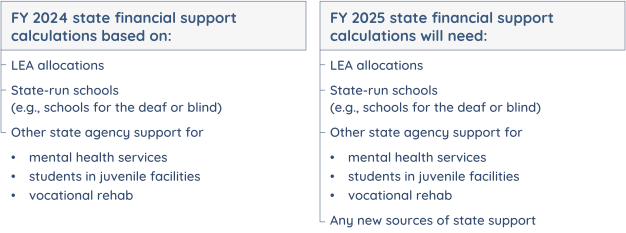
When reporting year-to-year information in Section V, the comparison calculations must be based on the same components, plus any new funding for special education that was not reported previously. For example, if the state fiscal year 2024 amount is based on allocations to LEAs, mental health services, and vocational rehabilitation services provided to children with disabilities, the calculation for fiscal year 2025 must be based on those same components, as well as any new sources of state funding for special education and related services.
Exhibit 1: Comparison calculations for state financial support
What adjustments can be made to the amount of state financial support under the MFS requirement?
No adjustments can be made to lower the state financial support amount. However, states may apply for a one-year waiver for meeting the MFS requirement, “due to exceptional or uncontrollable circumstances such as a natural disaster or a precipitous and unforeseen decline in the financial resources of the state” (34 CFR §300.163(c)(1)). When a waiver is approved, a state is allowed to reduce financial support for a single year. In the following year, the required level of financial support reverts to the level prior to the waiver.
Questions for states to consider
What is the state's process for collecting and documenting fiscal data for Section V in the state application?
Establishing a clear process and standardized documentation will enable staff to calculate state financial support in a consistent manner from year to year.
How is support from other state agencies reflected in the state's MFS calculations?
States might not necessarily appropriate funds to other agencies for the explicit purpose of providing services to children with disabilities. State staff may need to review their expenditures in order to make a reasonable approximation of the amount of money that was made available for such services.
Are state staff prepared to explain the Section V amounts and/or discrepancies across annual applications?
The Office of Special Education Programs (OSEP) at the U.S. Department of Education may reach out to states to clarify what was reported. Documenting explanations internally at the time of reporting will make it easier to answer OSEP’s questions.
How is the state building continuity in state staff knowledge about state funding for special education?
State MFS requirements are complex and have high stakes. Given that state departments of education may face both expected and unexpected staff turnover, it is important to establish clear documentation and share knowledge among selected staff on a continuous basis to help manage these changes.
For more information, see CIFR's library of Part B MFS resources.
This resource was initially published in 2015, under a grant from the U.S. Department of Education, #H373F140001. This page was last updated in May 2026.
Suggested Citation: Center for IDEA Fiscal Reporting. (n.d.). Quick reference guide on IDEA maintenance of state financial support. WestEd. Retrieved [date], from https://cifr.wested.org/guide/quick-reference-guide-on-idea-maintenance-of-state-financial-support/