
At a Glance: This guide provides an overview of how states allocate Part B funds to local educational agencies under the Individuals with Disabilities Education Act (IDEA).
What are IDEA Part B subgrants to local educational agencies?
The federal government provides funding through two types of IDEA Part B grants to states and territories that then flow to local educational agencies (LEAs) as subgrants. Every eligible state or territory receives an annual federal grant under the IDEA, called a Section 611 grant, to support special education and related services for children ages 3 through 21. All 50 states (as well as District of Columbia and Puerto Rico) also receive Section 619 grants, which are IDEA funds to support the education of children ages 3 through 5.
Each state educational agency (SEA) may set aside a portion of its Section 611 and Section 619 grants for administrative and other state-level activities. After reserving grant funds for state-level activities, SEAs must use a specific formula to allocate the remaining funds as subgrants to LEAs, including charter school LEAs. This formula, required by the regulations, consists of a base payment amount and amounts that are determined by population and poverty measures for each LEA. The formula is applied separately to Section 611 and Section 619 subgrants.
Which LEAs are eligible for IDEA Part B subgrants?
For both Section 611 and Section 619, LEAs are eligible to apply for subgrants if they meet the state’s definition of an LEA and are responsible for providing a free appropriate public education (FAPE) to children with disabilities under IDEA. LEAs do not need to be serving children with disabilities to be eligible for Section 611 and Section 619 subgrants. This stipulation ensures that LEAs have funds available to identify or serve children with disabilities who subsequently enroll or are identified during the year.
To receive Section 611 and Section 619 subgrants, each LEA must submit an application to the state. The application must provide assurances that the LEA meets specific requirements regarding the use of funds and has policies and procedures in place to ensure that children with disabilities receive FAPE.
States must provide Section 619 subgrants to LEAs that serve children ages 3 through 5 and have submitted approvable subgrant applications. LEAs do not need to have preschool programs in order to be eligible for Section 619 subgrants—the subgrants are made based on the ages of children served, not grade levels. If an LEA could serve 5-year-olds in kindergarten, regardless of whether the children have disabilities, the LEA is eligible for a Section 619 subgrant. However, if an LEA is not responsible for educating children ages 3 through 5, such as an LEA with only a high school, it is not eligible for a Section 619 subgrant.
For both Section 611 and Section 619, charter school LEAs are eligible to apply for subgrants if they are responsible for providing FAPE to children with disabilities under the IDEA. Charter schools that are not LEAs under state law are not eligible.
Section 611 Subgrants to LEAs (for students ages 3–21)
“Each State that receives a grant under section 611 of the Act for any fiscal year must distribute any funds the State does not reserve under §300.704 to LEAs (including public charter schools that operate as LEAs) in the State that have established their eligibility under section 613 of the Act for use in accordance with Part B of the Act. Effective with funds that become available on July 1, 2009, each State must distribute funds to eligible LEAs, including public charter schools that operate as LEAs, even if the LEA is not serving any children with disabilities.”
34 CFR §300.705(a)Section 619 Subgrants to LEAs (for students ages 3–5)
“Each State that receives a grant under section 619 of the Act for any fiscal year must distribute all of the grant funds the State does not reserve under §300.812 to LEAs (including public charter schools that operate as LEAs) in the State that have established their eligibility under section 613 of the Act. Effective with funds that become available on July 1, 2009, each State must distribute funds to eligible LEAs that are responsible for providing education to children aged three through five years, including public charter schools that operate as LEAs, even if the LEA is not serving any preschool children with disabilities.”
34 CFR §300.815
Why are accurate allocations of IDEA Part B subgrants to LEAs important?
For allocation of subgrants to LEAs, IDEA prescribes a specific formula that must be followed. When SEAs incorrectly allocate these subgrants, some LEAs may not receive the full amount of federal funding to which they are entitled in order to provide direct services to children with disabilities or to carry out other permissible activities, such as child find or professional development. The SEA may have to retroactively restore funding to any LEAs that did not receive an accurate amount.
What are base payments, and how are they calculated?
The 1997 reauthorization of the IDEA changed the mechanism for making subgrants to LEAs from basing the amount on the number of children with disabilities to instead providing a static base payment and amounts determined by population and poverty measures. The revised formula went into effect in federal fiscal year (FFY) 1999 for Section 611 and in FFY 1997 for Section 619.
The base payment for Section 611 is the amount that an LEA would have received if the SEA had distributed 75 percent of the state’s FFY 1999 Section 611 grant, using the 1998 count of children with disabilities ages 3 through 21 in the LEA. For Section 619, the base payment is the amount that an LEA would have received if the SEA had distributed 75 percent of the state’s FFY 1997 Section 619 grant, using the 1996 count of children with disabilities ages 3 through 5 in the LEA.
The individual LEA base payment amounts stay the same from year to year unless adjustments are required (see next section). However, even if LEA base payments change, the total statewide base payment does not change.
Under what circumstances must adjustments be made to base payments?
Base payments for Section 611 and Section 619 subgrants must be adjusted when:
- A new LEA, including a new charter school LEA, is created;
- Two or more LEAs combine into a new, single LEA;
- Two or more LEAs change geographic boundaries or administrative responsibility for providing services to children ages 3 through 21 for Section 611, or to children ages 3 through 5 for Section 619 (including as a result of one or more of the LEAs closing);
- An LEA that had a base payment of zero in its first year of operation (because it did not serve children with disabilities) now serves children with disabilities; or
- A charter school LEA significantly expands its enrollment.
See 34 CFR §300.705 (b)(2) and §300.816(b) for more details on these circumstances, and 20 U.S.C. 7221(e) for the requirement that SEAs must ensure that new and expanding charter school LEAs receive the federal formula funds for which they are eligible.
How are the remaining IDEA funds allocated?
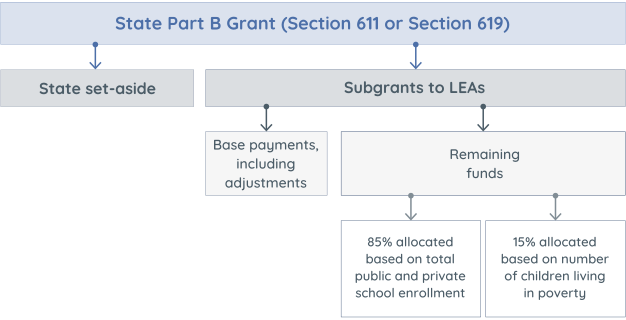
After subtracting from the total state grant the amount of the set-aside for state-level activities and the amount needed for base payments to all eligible LEAs, the SEA divides any remaining funds among LEAs according to population and poverty measures. This process is done for Section 611 and Section 619 grants separately. The state must:
- Allocate 85 percent of the remaining funds to eligible LEAs, including charter school LEAs, on the basis of each LEA’s relative number of children enrolled in public and private elementary schools and secondary schools that are within the LEA’s jurisdiction; and
- Allocate 15 percent of the remaining funds to eligible LEAs, including charter school LEAs, on the basis of each LEA’s relative number of children living in poverty, as determined by the SEA.
For more details, see 34 CFR §§300.705(b)(3) and 300.816(c). It is important to note that the population and poverty calculations are based on total enrollment of children in public and private schools, and not limited to the enrollment of children with disabilities. The SEA uses the same LEA population and poverty counts for both Section 611 and Section 619 subgrants.
The state has discretion to set aside less than the maximum allowable for state-level activities and to instead use those funds to increase the amount available for flow-through funding to LEAs through the population and poverty calculations.
Exhibit 1: Allocation of IDEA Part B funds for state activities and to LEAs
Under what circumstances may states reallocate IDEA Part B funds that have been allocated to an LEA?
Under specific circumstances, an LEA may return Part B funds. If an SEA determines that any portion of a Section 611 or Section 619 subgrant is not needed by a particular LEA to provide FAPE to children with disabilities, the SEA may reallocate those funds to other LEAs in the state that are “not adequately providing special education and related services to all children with disabilities residing in their jurisdictions” (34 CFR §§300.705(c) and 300.817). The state must have procedures in place to determine that the LEA which is returning funds is providing FAPE and that other LEAs are “not adequately providing special education and related services.”
An SEA may also redistribute Section 611 or Section 619 subgrants that had been allocated to an eligible LEA if that LEA is no longer serving any children with disabilities and the SEA determines that the LEA will not use the funds. The SEA may reallocate those funds to other LEAs in the state that are “not adequately providing special education and related services to all children with disabilities” (34 CFR §§300.705(c) and 300.817).
If the state has not reserved the maximum amount allowed for a state set-aside, then the SEA may choose to retain funds that have been returned from an LEA that does not need them, or from an LEA not serving children with disabilities, for use at the state level. For more details, see 34 CFR §§300.705(c) and 300.817.
Questions for states to consider
Does the SEA have written procedures for allocating Section 611 and Section 619 subgrants to LEAs?
Written procedures help ensure that the allocations are made consistently and appropriately.
Does the SEA allocate Section 619 funds to LEAs, including charter school LEAs, that do not have preschools but do (or could) serve 5-year-olds in kindergarten?
Section 619 funds can be used for specific activities related to special education (e.g., child find, evaluations) for all children ages 3 through 5, regardless of whether they are served in preschool or in kindergarten and regardless of whether they are children with disabilities. Eligible LEAs that serve (or could serve) 5-year olds in kindergarten, regardless of whether the LEAs have preschool programs, should receive allocations based on population and poverty calculations and base payment, if appropriate.
How does the SEA obtain information to determine if base payment adjustments are needed?
To prepare for adjustments in a timely manner, SEAs should have a procedure, including timelines, to obtain notifications of the circumstances that require a base payment adjustment. For example, the SEA may require that a new charter school LEA notify the State Board of Education in writing that the LEA will be opening at least 90 days prior to opening.
For more information, see CIFR's library of Part B allocation resources.
This resource was initially published in 2017, under a grant from the U.S. Department of Education, #H373F140001. This page was last updated May 2026.
Suggested Citation: Center for IDEA Fiscal Reporting. (n.d.). Quick reference guide on the allocation of IDEA Part B subgrants to local educational agencies. WestEd. Retrieved [date], from https://cifr.wested.org/guide/quick-reference-guide-on-the-allocation-of-idea-part-b-subgrants-to-local-educational-agencies/