
At a glance: This guide helps states understand how to apply indirect costs to Part C grants under the Individuals with Disabilities Education Act (IDEA).
What are direct and indirect costs?
Costs that can be directly attributed to implementing the requirements of a particular grant or program are known as direct costs (2 CFR §200.413). Most federal IDEA Part C funds are spent on direct costs, such as those for personnel (all direct salaries and wages, applicable fringe benefits), materials and supplies, services, travel, professional development, contracts with local agencies for the provision of early intervention services, and costs associated with implementing and maintaining an Interagency Coordinating Council.
Some expenses, however, cannot be reliably attributed to the Part C program as direct charges. These costs may include a portion of facilities and administration costs associated with agencywide functions such as human resources, accounting, payroll, information technology or procurement units serving the state’s lead agency (LA) that administers Part C. Such indirect costs typically benefit multiple programs within the state LA.
Although there is no universal rule for determining whether a cost is direct or indirect, the Office of Management and Budget’s Uniform Administrative Requirements, Cost Principles, and Audit Requirements for Federal Awards (commonly called “OMB Uniform Guidance”) should be consulted when making a determination about indirect costs.
What is an indirect cost rate and a restricted indirect cost rate for Part C?
An indirect cost rate is a method for determining the amount of indirect costs that can be charged to a grant or project. Because IDEA Part C funds are intended to primarily support services and activities that directly benefit infants and toddlers with disabilities and their families, state LAs that choose to charge indirect costs must use a restricted indirect cost rate. A restricted indirect cost rate limits the types of administrative expenditures that may be charged to the Part C grant.
State LAs are not required to charge indirect costs to the Part C grant. However, if they opt to do so, they must use a restricted indirect cost rate—or a cost allocation plan with indirect costs calculated on a restricted basis—and obtain prior approval from both their cognizant agency (i.e., the federal agency responsible for reviewing, negotiating, and approving cost allocation plans or indirect cost proposals) and the U.S. Department of Education’s Indirect Cost Division.
Requirement regarding indirect costs
“(2) If approved by the lead agency’s cognizant Federal agency or by the Secretary, the lead agency must charge indirect costs through either–
- (i) A restricted indirect cost rate that meets the requirements in 34 CFR 76.560 through 76.569; or
- (ii) A cost allocation plan that meets the non-supplanting requirements in paragraph (b) of this section and 34 CFR part 76 of EDGAR.
(3) In charging indirect costs under paragraph (c)(2)(i) and (c)(2)(ii) of this section, the lead agency may not charge rent, occupancy, or space maintenance costs directly to the part C grant, unless those costs are specifically approved in advance by the Secretary.”
34 CFR §303.225(c)(2)-(3)
What is a cost allocation plan for Part C?
If the state’s LA is not the state educational agency (SEA), the state has an option of charging indirect costs to the Part C grant through a cost allocation plan. A cost allocation plan distributes allowable agencywide direct and indirect costs across several programs or projects within the state LA. The plan identifies the methods for sharing costs across agency programs or projects. When an LA is not an SEA and has a cost allocation plan, charges must be calculated on a restricted basis.
“Cost Allocation Plans (CAPS) may be necessary when substantial direct costs of programs consist of joint or common cost distributions and/or when the nature of the grantee’s activities is such that direct costs cannot be adequately determined with reasonable precision.”
Source: Indirect Cost Group. (2019). Cost Allocation Guide for State and Local Government, page 16.
Why are restricted indirect cost requirements important for Part C?
Restricted indirect cost requirements are important for Part C programs because they establish uniform standards of allowable, reasonable, and allocable costs, as defined in 2 CFR §200.403 through 200.405. IDEA requires that federal funds be used to supplement and not supplant state and local funds. To ensure that Part C funds are not being used in place of (i.e., supplanting) other state and local funds available to cover administrative and operation costs, restricted indirect cost requirements for Part C exclude some indirect costs commonly included in non-IDEA grants.
Who approves a restricted indirect cost rate or cost allocation plan?
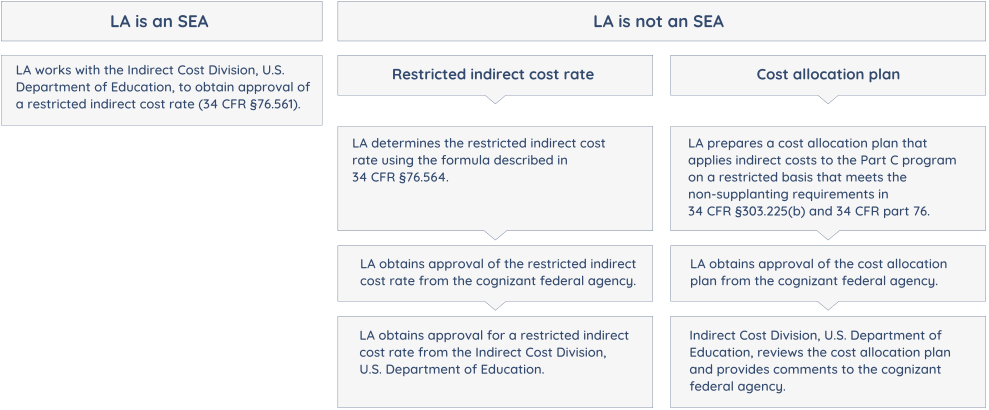
The restricted indirect cost rate or cost allocation plan must be approved by the state LA’s cognizant federal agency for indirect costs and the U.S. Department of Education’s Indirect Cost Division. The approval process differs depending on whether the state LA for Part C is or is not an SEA (see Figure 1).
Figure 1: Process to Obtain Approval for a Part C Restricted Indirect Cost Rate or Cost Allocation Plan
What are the reporting requirements for applying restricted indirect costs to Part C grants?
Annually, each state’s LA must submit a grant application to the U.S. Department of Education to receive its Part C funding. The state LA must indicate in the application whether it intends to charge indirect costs to its Part C grant and—if it does—report the status of its restricted indirect cost rate or cost allocation plan.1 If a state LA elects to charge restricted indirect costs to the Part C grant, appropriate documentation for the status of its restricted indirect cost rate or cost allocation plan must accompany the grant application. The state LA also must indicate the total amount budgeted for indirect costs in Section III.F.
Questions for states to consider
Who can work with state Part C staff to help them understand their program’s restricted costs process?
The finance office or fiscal management division of the state LA leads efforts to obtain approval of a restricted indirect cost rate or cost allocation plan. State Part C staff should familiarize themselves with who is responsible for this process within the LA and work closely with them throughout the process.
Has the state LA’s current restricted indirect cost rate been approved by the U.S. Department of Education?
If the Part C staff are unaware of whether the state LA has an approved rate, they should reach out to the finance staff of the state LA to address the question. An LA may have an approved indirect rate, but the rate must be restricted and must be approved by the cognizant agency and reviewed by the Indirect Cost Division in the U.S. Department of Education for the purposes of Part C. If the rate has not been approved, indirect expenses cannot be charged to the Part C grant.
Does the LA have sufficient time to negotiate a restricted rate or gain approval of a cost allocation plan prior to the deadline for the next application?
Prior to including indirect expenses in a grant application budget, state staff should coordinate with the required federal agencies to estimate a realistic timeline for necessary steps and approvals. State Part C staff should work closely with their state LA finance staff and their contact at the Office of Special Education Programs, U.S. Department of Education, to plan a process that will allow for time to negotiate the indirect cost rate or—if an LA has a cost allocation plan and has a cognizant agency other than the U.S. Department of Education—to determine the charges calculated on a restricted basis. Staff should also factor in time to obtain final review from the U.S. Department of Education Indirect Cost Division.
For more information, see CIFR's library of resources on restricted indirect cost rates or cost allocation plans for Part C.
Endnotes
- ^ The status is reported in Section IV.B. of the grant application. States must indicate whether they: (1) have a current final restricted indirect cost rate agreement; (2) are operating under a provisional or expired rate while negotiating a new one; or (3) use an approved cost allocation plan. Required documentation must accompany the reported status.
This resource was initially published in 2021, under a grant from the U.S. Department of Education, #H373F200001. This page was last updated May 2026.
Suggested Citation: Center for IDEA Fiscal Reporting. (n.d.). Quick reference guide on restricted indirect costs and cost allocation plans for IDEA Part C grants. WestEd. Retrieved [date], from https://cifr.wested.org/guide/quick-reference-guide-on-restricted-indirect-costs-and-cost-allocation-plans-for-idea-part-c-grants/