
At a glance: This guide provides an overview of IDEA Part B state set-aside funds, including allowable uses and key fiscal requirements under the Individuals with Disabilities Education Act (IDEA).
What are IDEA Part B state set-aside funds?
Under IDEA Section 611, every eligible state and outlying area receives an annual grant to support special education and related services for children ages 3–21. Additionally, all states, including the District of Columbia and Puerto Rico, receive IDEA Section 619 grants to support special education and related services for children ages 3–5.
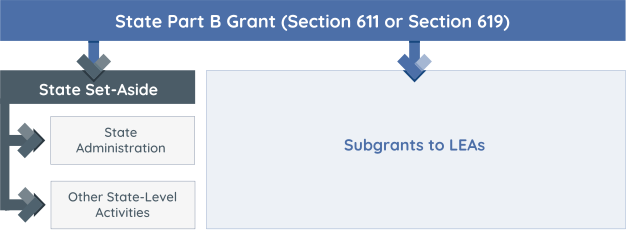
Each state may reserve a limited amount of its Section 611 and Section 619 grants for state administration of the IDEA Part B program and for other state-level activities. These are commonly referred to as “state set-aside funds.” States must allocate any remaining funds as subgrants to local educational agencies (LEAs), including charter school LEAs (see Exhibit 1). For more detail on the formula for allocating LEA subgrants, see CIFR’s At A Glance: IDEA Part B Grants to States and Subgrants to Local Educational Agencies.
Exhibit 1. IDEA Part B Funds for State Activities and Subgrants to LEAs
Why are state set-aside funds important?
States use Part B funds to administer, coordinate, and implement state-level activities, including technical assistance, to support children with disabilities. These funds make it possible for states to fulfill their general supervision responsibilities under 34 CFR §300.149 and achieve the goals of IDEA.
How are the maximum set-aside amounts calculated?
Funds set aside for state administration and for other state-level activities are calculated and used differently. The Office of Special Education Programs (OSEP) at the U.S. Department of Education shares the maximum amounts available for each category when notifying states about their Section 611 and Section 619 grant awards.
The methods for calculating Section 611 state set-aside maximums are detailed in 34 CFR §300.704(a) and (b) 1:
- For state administration, the maximum amount is equal to the maximum amount the state was eligible to reserve for federal fiscal year (FFY) 2004 or $800,000, adjusted for inflation, whichever is greater, or, for outlying areas, 5 percent of the award it receives currently or $35,000, whichever is greater.
- For other state-level activities, the maximum amount is equal to a percentage of the state’s grant award for FFY 2006, adjusted for inflation. The percentage varies depending on the amounts reserved for state administration and whether the state uses Part B dollars to support a high-cost fund for LEAs under 34 CFR §300.704(c).
OSEP calculates maximum state set-asides for Section 619 differently (see 34 CFR §§300.812–300.814):
- The total maximum available for both state administration and other state activities combined is 25 percent of the amount the state received for 1997, cumulatively adjusted by the lesser of (a) the percentage increase from the prior year’s award, or (b) the rate of inflation from the preceding FFY.
- The maximum amount that can be used for state administration is 20 percent of the total reserved amount authorized above.
- The state must spend the remaining amount of the total reserved on other state-level activities.
The state may reserve less than the maximum allowable for state set-aside funds, resulting in more funds from the total grant available to allocate to LEAs as subgrants, following IDEA requirements in 34 CFR §§300.705 and 300.816.
What are the allowable uses of state administration set-aside funds?
There are a variety of permitted uses of Section 611 funds reserved for state administration. States may use these amounts to administer both Section 611 and Section 619. The funds may also be used to coordinate activities with and provide technical assistance to other programs that provide services to children with disabilities as well as to operate an LEA high cost fund under 34 CFR §300.704(c).
As noted above, OSEP adjusts the maximum allowed for administration for inflation. When this occurs, states may use the inflationary increases to the Section 611 administration maximum for selected activities as provided for in 34 CFR §300.704(e). These targeted activities include providing support and direct services, helping LEAs provide positive behavioral interventions and supports and mental health services for children with disabilities, assisting LEAs in meeting personnel shortages, and supporting capacity-building activities and improving the delivery of services by LEAs.
Finally, Section 611 state administration funds may be used to support early intervention services (EIS) pursuant to 34 CFR §300.704(f). States eligible to receive a Section 619 grant may use Section 611 set-aside dollars to provide EIS to preschool-aged eligible children with disabilities who previously received services under IDEA Part C. This effort must be jointly developed with the Part C lead agency and include an educational component that promotes school readiness and incorporates preliteracy, language, and numeracy skills. These EIS may be provided until the children enter school.
The uses of Section 619 funds reserved for state administration are more restricted. States may use these funds to administer Section 619 and Part C as well as to coordinate with and provide technical assistance to other programs that provide services to children with disabilities.
What are the allowable uses of set-aside funds for other state-level activities?
IDEA permits a variety of uses of funds reserved for other state-level activities (see Table 1). However, when a state reserves Section 611 funds for other state-level activities, 34 CFR §300.704(b)(3) requires the state to budget some portion of those funds
- for monitoring, enforcement, and complaint investigation; and
- to establish and implement the mediation process, including costs of mediators and support personnel.
Table 1. Permissible Uses of Part B Funds Reserved for Other State-Level Activities
| Section 611 other state-level activities | Section 619 other state-level activities |
|---|---|
|
|
*Required uses if the state reserves Section 611 funds for other state-level activities.
How do states report budgeted state set-aside amounts?
Section III of the annual state grant application for IDEA Part B funds requires states to report to OSEP how they will use the reserved Section 611 amounts across the specific permitted activities. States do this by completing and submitting a form called the Excel Interactive Spreadsheet with their Part B grant applications. OSEP provides this spreadsheet to states as part of the annual application packet.
OSEP does not require states to report amounts reserved and budgeted for Section 619 set-aside amounts in the grant application. Nevertheless, states must use the funds in a manner consistent with regulations and should document budgeted and expended amounts.
What happens if a state changes its state set-aside budget?
States may adjust their budgets for Section 611 set-aside funds, but changes above a certain threshold require preapproval from OSEP. Transfers between budgeted activities that add up to more than 10 percent of the total amount of funds reserved for state-level activities require approval in advance. In such cases, states must submit a revised Excel Interactive Spreadsheet to OSEP for approval. See 2 CFR §200.308(i).
Questions for states to consider
How does your state decide how to use state set-aside funds, and is the process documented?
State educational agencies (SEAs) manage many steps and decisions to budget state set-aside amounts each year, involving multiple staff and departments within the SEA. SEAs should establish and document processes for making budget decisions and for entering Section 611 budget information into the annual Excel Interactive Spreadsheet. Written procedures support accurate and consistent reporting and tracking of set-aside budgets by providing specific guidance to staff and by clarifying roles and responsibilities across departments within the SEA.
How are set-aside funds for other state-level activities used to meet state priorities?
Whether set-aside funds address personnel shortages, support transition programs, or build the capacity of LEAs to deliver services and improve results for children with disabilities, their use should align with state priorities. States may want to create procedures to evaluate changes in program needs and state priorities and align the use of state set-aside funds with those needs. State annual performance indicator data, student outcomes, input from LEAs, evidence of the effectiveness of current activities, and analysis of changing needs can all be used to inform budgeting decisions for state set-aside funds.
Has your state considered the crossover between Section 611 and Section 619 set-aside funds?
Although uses for other state-level activities funds differ between Section 611 and Section 619 (as shown in Table 1), both grants are intended to serve children with disabilities ages 3–5. There may be ways to purposefully leverage set-aside funds to support both programs in your state. Additionally, the funds can be used to support some Part C early intervention services at the state’s discretion. Each SEA should consider its own needs and structure to determine whether and how these funds should be used.
For more information, see CIFR's library of IDEA Part B set-aside funds
Endnotes
- ^ There is a different set-aside calculation for the Bureau of Indian Education under 34 CFR §300.710(a), which specifies that the Secretary of the Interior can reserve up to 5 percent of its grant, or $500,000, whichever is greater, for administrative costs. No other state-level activities set-aside amount is authorized.
This resource was initially published in 2023, under a grant from the U.S. Department of Education, #H373F140001. This page was last updated May 2026.
Suggested Citation: Center for IDEA Fiscal Reporting. (n.d.). Quick reference guide on IDEA Part B set-aside funds. WestEd. Retrieved [date], from https://cifr.wested.org/guide/quick-reference-guide-on-idea-part-b-state-set-aside-funds/