

At a glance: This guide explains the maintenance of effort requirement under Part B of the Individuals with Disabilities Education Act (IDEA), including calculation methods, consequences for noncompliance, and options for reducing the required amounts.
What is local educational agency maintenance of effort?
The maintenance of effort (MOE) requirement obligates any local educational agency (LEA) receiving IDEA Part B funds to budget and spend at least the same amount of local—or state and local—funds for the education of children with disabilities on a year-to-year basis (see below for regulatory language). The required MOE levels are referred to as the “eligibility standard” for budgeting and the “compliance standard” for spending.
Why is LEA MOE important?
The LEA MOE requirement helps to ensure that LEAs supplement and do not supplant (replace) federal funds. The requirement protects state and local funds essential to providing special education and related services, ensures consistent investment for those services, and promotes stability and long term planning.
What are the consequences for failing to meet the MOE standards?
An LEA is not eligible to receive IDEA Part B funds until it has met the MOE eligibility (i.e., budget) standard. If an LEA fails to meet its MOE compliance (i.e., expenditure) standard, the state educational agency (SEA) must repay the U.S. Department of Education. The state’s repayment obligation—which must be met using nonfederal funds or funds for which accountability to the federal government is not required—is either the difference between what the LEA actually spent and what it should have spent to meet the MOE requirement, or the amount of the LEA’s Part B subgrant for that fiscal year, whichever is lower. The SEA can require the LEA to reimburse the SEA for this amount or can opt to cover the penalty itself.
“For purposes of establishing the LEA's eligibility for an award for a fiscal year, the SEA must determine that the LEA budgets, for the education of children with disabilities, at least the same amount, from at least one of the following sources, as the LEA spent for that purpose from the same source for the most recent fiscal year for which information is available: (i) Local funds only; (ii) The combination of State and local funds; (iii) Local funds only on a per capita basis; or (iv) The combination of State and local funds on a per capita basis.”
34 CFR §300.203(a)(1)“Except as provided in §§ 300.204 and 300.205, funds provided to an LEA under Part B of the Act must not be used to reduce the level of expenditures for the education of children with disabilities made by the LEA from local funds below the level of those expenditures for the preceding fiscal year.”
34 CFR §300.203(b)(1)“An LEA meets this [compliance] standard if it does not reduce the level of expenditures for the education of children with disabilities made by the LEA from at least one of the following sources below the level of those expenditures from the same source for the preceding fiscal year, except as provided in §§ 300.204 and 300.205: (i) Local funds only; (ii) The combination of State and local funds; (iii) Local funds only on a per capita basis; or (iv) The combination of State and local funds on a per capita basis.”
34 CFR §300.203(b)(2)
How is MOE calculated?
For both standards, LEAs have four methods to demonstrate they have met the MOE requirement:
- Total amount of local funds,
- Total amount of state and local funds,
- Per capita (e.g., per child with disability) amount of local funds, or
- Per capita amount of state and local funds.
An LEA can use any of these four methods to meet MOE and may change the method used from year to year.
What is the comparison year for each standard?
To determine whether the LEA met MOE eligibility or compliance, the calculated year must be compared to the last year the LEA met the MOE compliance standard using the same method. For the eligibility standard, the amount an LEA budgets for the education of children with disabilities in a given fiscal year (calculated year) is compared to the amount spent in the most recent fiscal year for which information is available and in which the LEA met the MOE compliance standard using the same method (comparison year).
Similarly, for the compliance standard, the amount an LEA spends for the education of children with disabilities in a given fiscal year (calculated year) is compared to the amount spent in the most recent fiscal year in which the LEA met the MOE compliance standard using the same method (comparison year).
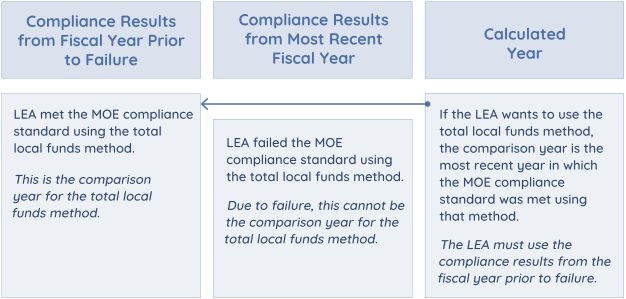
For example, if an LEA wants to use total local funds to meet MOE in a given fiscal year, the comparison year would be the most recent fiscal year in which it met the MOE compliance standard using total local funds. See Exhibit 1.
If an LEA fails to maintain effort during one fiscal year, its MOE obligation for that method the following year would be based on the expenditure level from the last year it met the MOE compliance standard. This ensures the LEA’s required budgeting or spending remains anchored to a year in which it maintained effort.
Exhibit 1. Comparison year example for a particular method
What are the allowable exceptions to MOE?
An LEA may reduce its MOE obligation for budgeting or expenditures if there is an allowable exception. Allowable exceptions are those due to:
- voluntary or for-cause departure of special education staff,
- decrease in enrollment of IDEA eligible children,
- termination of an exceptionally costly program for a particular child, under certain circumstances,
- termination of costly expenditures for long-term purchases, and
- assumption of cost by its SEA’s high-cost fund (see 34 CFR §300.204).
An LEA may reduce its budget for the education of children with disabilities if it anticipates an allowable exception in the coming school year, such as the expected retirement of a staff member. However, by reducing its budget in anticipation of an allowable exception later in the year, an LEA puts itself at risk of budgeting less than it will ultimately need to meet MOE, should the expected exception not occur.
Are there other ways to reduce the MOE obligation without penalty?
An LEA may reduce its MOE obligation by up to 50 percent of any increase over the preceding year in its IDEA Part B Section 611 allocation (see 34 CFR §300.205(a)). That is, if an LEA receives more IDEA Section 611 funds than it received for the previous fiscal year, it may reduce its state and/or local contributions by up to 50 percent of the amount of the increase. To adjust its MOE obligation in this manner, an LEA must:
- ensure that it provides free appropriate education for children with disabilities;
- the SEA must determine that the LEA “meets requirements” of the IDEA Part B;
- the SEA must not have taken action against the LEA under IDEA Section 616; and
- the LEA must not have been identified as having significant disproportionality (see 34 CFR §300.646(a)).
LEAs are also permitted to voluntarily use up to 15 percent of IDEA Part B Section 611 and Section 619 funds to provide coordinated early intervening services (CEIS). These are services provided to children who are not currently identified as needing special education or related services, but who need additional academic or behavioral support to succeed in general education. If an LEA chooses to take advantage of both provisions—using funds for CEIS and reducing its MOE obligation by up to 50 percent of its IDEA Section 611 funding increase—the combined total of Part B funds used under both provisions cannot exceed the lesser of the maximum dollar amounts available for either CEIS (15 percent of Section 611 and Section 619 funds) or MOE reduction (50 percent of the increase in Section 611 funds).
What are the Part B reporting obligations for MOE?
States report annually on MOE in EDFacts EDPass, the U.S. Department of Education's data submission and management system. States must report, for each LEA:
- the state’s determination of whether the LEA has met the requirements of Part B of IDEA,
- the amount, if any, by which the LEA reduced its MOE obligation under 34 CFR §300.205(a),
- whether the LEA has met the MOE compliance standard, and
- whether funds were returned to the U.S. Department of Education for failure to meet the MOE compliance standard.
Questions for states to consider
Do LEAs understand the four methods for calculating, and the allowable exceptions and adjustments for reducing, the budget and expenditure requirements of MOE?
LEAs may not fully understand the different methods they can use in calculating MOE or the allowable ways to reduce their MOE obligation.
How does the state’s accounting system track expenditures for the education of children with disabilities?
Some accounting systems may not disaggregate expenditures by state and local funds. This could limit the ability of LEAs to use the local-only options for calculating their MOE.
What are the SEA’s procedures for identifying LEAs that are eligible to use an IDEA Section 611 funding increase to adjust MOE?
SEAs are responsible for ensuring that only eligible LEAs reduce MOE by up to 50 percent of the IDEA Section 611 funding increase. Documented procedures for identifying eligible or ineligible LEAs and for identifying LEAs that intend to use this adjustment could help avoid potentially costly confusion.
For more information, see CIFR's library of LEA MOE resources
This resource was initially published in 2015, under grants from the U.S. Department of Education, #H373F140001 and #H373Y130002. This page was last updated May 2026.
Suggested Citation: Center for IDEA Fiscal Reporting & IDEA Data Center. (n.d.). Quick reference guide on IDEA local educational agency maintenance of effort. WestEd. Retrieved [date], from https://cifr.wested.org/guide/quick-reference-guide-on-idea-local-educational-agency-maintenance-of-effort/